Dungeon Rush
- 4.4
- Rating
- 100.00K
- Installs
- Free
- Price

 Analysis by App-foxy
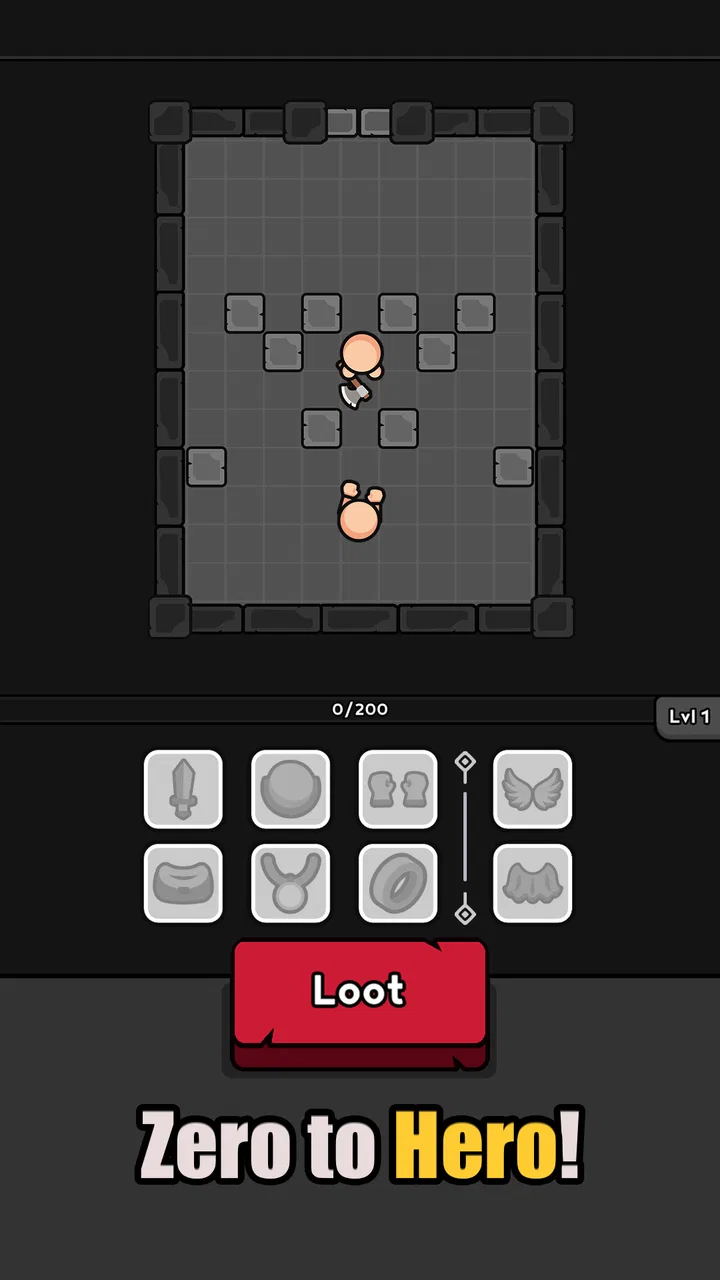
Dungeon Rush is the kind of strategy game I open when I want progress without committing to a long session. Its loop is easy to understand: defeat enemies, collect equipment, improve the character, and return for another run. That simplicity is its main appeal, but it also sets the right expectation. This is not a deep kingdom-management game or a slow tactical simulator. It is a compact dungeon-focused experience built around repeated advancement.
I approached it as a quick-play game rather than something demanding my full attention for an evening. That makes a difference. The short store summary, “Slay, Loot, Equip, Idle, Repeat!”, accurately points toward the rhythm, but the real question is whether that rhythm stays satisfying after the first few sessions. My answer is cautiously positive: it works best for players who enjoy watching a build become stronger through small improvements, while people looking for complex decision-making may find the structure too narrow.
How Dungeon Rush feels in everyday play
The opening appeal is its low barrier to entry. You do not need to learn a large collection of systems before understanding what you are doing. The dungeon setting gives each action an obvious purpose, and the combination of combat, loot, equipment, and idle progress makes it suitable for short visits. I can imagine playing it while waiting for a bus, taking a break from work, or winding down before bed without needing to remember a complicated plan.
You May Also Like

 Blood Strike: 2.5 Anniversary
Blood Strike’s Loadouts Turn Every Drop Into a Tactical Gamble
A close look at Blood Strike’s custom loadouts: how fast access to signature weapons reshapes its battle royale rhythm, rewards preparation, and narrows the gap between fights.

 Pandora - Music & Podcasts
Pandora’s Music Is Easy to Start, but Harder to Recover
Pandora’s strength is its low-effort path from a seed to a station. Its weak spot is how much confidence it asks you to place in connection, setup, and quiet recovery.

 8 Ball Pool
 Is Built on Rivalries, Rematches, and Routine
A close look at the rivalries, rematches, shared routines, and unanswered safety questions that turn a quick pool match into a persistent mobile community.

 Samsung Music
’s Quiet Strength Is Playing What You Already Own
Its reach comes less from spectacle than from dependable access to a personal library. That simplicity is both the app’s strongest retention engine and its ceiling.

 AccuWeather: Weather Radar
AccuWeather Review: A Quick, Clear Forecast for Everyday Decisions
For everyday plans, the best forecast is the one you can understand quickly. AccuWeather makes rain timing, radar, and local conditions easy to act on, with a few trade-offs.

 Hill Climb Racing
Why Hill Climb Racing Still Turns Crashes Into One More Run
A tiny car, a bumpy hill and one more upgrade: Hill Climb Racing keeps resurfacing because its simple chaos makes every near-miss feel personal.
More From Our News Desk
View All News


That accessibility is especially useful on a phone. Many strategy games ask me to manage several screens, currencies, timers, alliances, or maps at once. Dungeon Rush feels more focused. Its central question is usually whether the current character and equipment are strong enough to continue. When progress slows, the natural response is to return to earlier content, improve the setup, and try again.
The trade-off is that the game’s appeal depends heavily on whether repeated runs feel rewarding to you. If you like incremental growth, the cycle can be relaxing. If you prefer every battle to demand a fresh tactical solution, the repetition may become noticeable sooner. I would not choose this as my first recommendation for someone seeking a highly strategic game with elaborate planning. I would choose it for someone who enjoys a lighter form of strategy wrapped in a dungeon-crawling loop.
Speed expectations and the value of short sessions
Dungeon Rush presents itself as a game that should fit around the player rather than require a long uninterrupted sitting. The idle element supports that expectation because progress is not limited to constant manual attention. In practical terms, this makes the game easier to revisit throughout the day. A short check-in can still feel worthwhile if it lets me collect progress, adjust equipment, and prepare for the next attempt.
That does not mean every moment feels equally fast. Early progress is naturally easier to appreciate because each improvement has a visible effect on the character’s ability to move forward. Later, the same loop can feel slower when upgrades require more patience or when a previous setup stops being effective. I see that slowdown as part of the game’s design rather than a technical problem, but it is important for new players to distinguish between deliberate progression and sluggish performance.
One useful habit is to treat each visit as a small maintenance session. Instead of repeatedly forcing the same difficult section, I would first inspect the available equipment, make the most meaningful upgrade, and then test the result. This avoids wasting time on runs that are unlikely to succeed. It also makes the idle component more useful, because unattended progress can support a planned improvement rather than simply becoming a button I press without thinking.
For a realistic everyday example, I might play during a ten-minute lunch break. I would collect whatever progress is available, compare newly acquired equipment, make one or two changes, and start another run before returning to work. That is where the game makes the most sense to me. It offers a clear stopping point, and I do not feel that I have abandoned a complicated operation by closing it.
What happens during heavier play
The busiest moments are likely to come when several parts of the loop meet: combat is advancing, rewards are being collected, and I am making equipment decisions in quick succession. These moments are more demanding from a decision-making perspective than the basic idle cycle, even though the game remains approachable. The important question is not simply whether a new item is stronger, but whether it helps the current stage and fits the direction I am taking.
I found that the most sensible approach is to avoid changing everything at once. If I replace every piece of equipment after each reward, it becomes harder to understand which improvement actually helped. A better workflow is to identify the weakest part of the current setup, change that first, and then test the next run. This is a small but valuable discipline in a game built around frequent loot decisions.
There is also a trade-off between active attention and convenience. Idle progress is useful when I am busy, but it can make the game feel less interactive if I rely on it too heavily. Active play gives me more ownership over the improvement process, while idle progress keeps the account moving when I cannot play. I would use the two modes differently: idle progress for background advancement, and active sessions for evaluating equipment and dealing with a roadblock.
Players should also be careful with the temptation to spend simply to remove a moment of friction. The game is free to download, but optional purchases range from $0.99 to $99.99 per item. That wide range makes it especially important to decide in advance how much convenience is worth to you. I would first learn whether a difficult section can be solved through ordinary progression before considering a purchase. For a casual game, protecting that boundary helps keep the experience enjoyable rather than turning every slowdown into a spending decision.
Reliability, recovery, and returning after a break
Dungeon Rush is most comfortable when I can leave it and return without needing to reconstruct a complicated plan. Its focused loop helps with that. I do not need to remember a large map or a long chain of objectives; I can usually begin by checking current progress and equipment. That makes recovery from a missed day or an irregular playing schedule less intimidating than in many larger strategy games.
There is a difference, however, between recovering from a break and recovering from a failed run. A failed attempt is useful only if it tells me something. I would use it to identify whether the problem is insufficient strength, an outdated equipment choice, or simply pushing beyond the point where another upgrade is sensible. Repeating the same attempt without changing anything is the least productive way to play this type of game.
Because Dungeon Rush is built around repeated advancement, I also recommend keeping expectations modest when returning after several days away. The game is not necessarily about completing everything in one sitting. A better mindset is to resume the loop, gather what has accumulated, and make one clear improvement. That approach reduces the feeling that I have fallen behind and makes the game feel more like a routine than a race.
My confidence in the overall experience is helped by its current public reception. It holds a 4.1 average from around 351 ratings, with roughly 29 written reviews, and it has passed 50K installs. Those figures suggest a modest but real player base rather than a completely untested release. They do not guarantee that every device or player will have the same experience, so I would still judge it by whether its repetitive structure matches my own preferences.
Device constraints and practical expectations
The listed minimum operating system is Android 7.0, which makes the game accessible to many older Android phones and tablets. That is useful for players who keep a secondary device for casual gaming or do not upgrade frequently. Still, an older supported operating system does not automatically mean identical performance across all hardware. Screen size, available storage, background activity, and general device condition can all affect how comfortable a game feels.
I would approach installation with ordinary mobile-gaming caution. Keeping the operating system updated where possible, closing unusually demanding background apps, and leaving enough free storage are sensible steps before blaming the game for a rough session. These actions do not transform a weak device into a powerful one, but they reduce avoidable friction and make it easier to tell whether a problem is local to the phone.
Resource demands are also worth considering in relation to the game’s intended use. A title designed around short dungeon visits is more convenient if it does not force me to keep it open for long periods. I would avoid leaving any mobile game running unnecessarily when the phone is already warm, low on battery, or handling navigation and messaging. The idle concept is most useful when it supports flexible play, not when it encourages constant background use.
Players on older devices should pay attention to how the game behaves during longer sessions rather than judging it only from the first launch. A quick opening tells me little about sustained comfort. If the phone begins to heat up, battery life becomes a concern, or switching between the game and other apps becomes awkward, shorter sessions are the practical solution. For someone with a very limited device, a simpler offline strategy game may still be a better fit.
How it compares with other strategy choices
Compared with traditional turn-based strategy games, Dungeon Rush asks for less planning before each action. I do not approach it expecting a carefully constructed battlefield puzzle. Its strength is the steady connection between defeating enemies and improving the character. That makes it easier to play casually, but it also means it may feel lightweight beside games with deeper positioning, resource management, or campaign decisions.
Compared with larger idle RPGs, its dungeon focus is more direct. I am not looking for a broad world or a large social layer here; I am following a compact loop of combat and equipment. That can be refreshing when I want fewer distractions. On the other hand, a player who enjoys collecting many characters, coordinating teams, or managing a more elaborate long-term system may find the experience limited.
The closest alternative for many people may be a standard action dungeon game. Those games usually reward reflexes and direct control, while Dungeon Rush is better suited to gradual progression and repeated optimization. If I want to actively dodge, aim, or react every second, I would choose the action alternative. If I want to check progress, make a gear decision, and let the next attempt unfold with less pressure, Dungeon Rush is the more comfortable option.
This comparison also explains who should skip it. I would not recommend it to someone who dislikes idle mechanics, repeated battles, or purchases appearing as a possible shortcut. I would also steer away players who need a strong narrative reason to continue. The game’s motivation comes primarily from advancement and equipment, so its appeal depends on enjoying that mechanical reward rather than expecting a story-led adventure.
Small habits that make the loop better
My first practical tip is to separate collecting from spending. Gathering rewards feels satisfying, but immediately using everything can leave me with no clear sense of which upgrade matters. I prefer to review the available equipment together, identify the bottleneck, and spend toward that specific problem. This makes each improvement easier to evaluate.
My second tip is to use idle progress as preparation, not as a substitute for all interaction. If I let the game advance in the background and then simply repeat the same action, I miss the strategic part that gives the loop meaning. I get more from returning with a question in mind: what has changed, and which upgrade gives me the best chance of moving forward?
My third tip is to set a personal purchase rule before playing regularly. Since the game is free and includes optional items priced from $0.99 up to $99.99, deciding in advance whether I will spend anything prevents an emotional response to a difficult stage. If I do spend, I would treat it as a convenience purchase rather than proof that the game requires payment to be enjoyable.
A fourth useful habit is to stop after a meaningful improvement instead of forcing a long session. When I have upgraded the weakest part of the setup and started a new run, that is often a good stopping point. Returning later lets the result feel like progress rather than turning the game into a repetitive chore. This is particularly helpful for players who enjoy the idle side but do not want the game to occupy their whole day.
Who will enjoy it most
Dungeon Rush is a good match for a player who wants a free strategy game with a straightforward dungeon loop and flexible session length. It suits people who enjoy incremental upgrades, equipment choices, and the satisfaction of returning to a stronger character. The Everyone age rating also makes its presentation broadly approachable, although individual preferences about repetition and optional spending still matter more than the label alone.
I can also see it working well as a secondary game. It does not need to replace a deeper strategy title or a more active action game. Instead, it can fill the gaps between them: a few minutes in the morning, a quick check during a break, or a relaxed session when I do not want to learn another complicated system. That role is where its focused design feels most convincing.
It is less suitable for someone who wants constant novelty. The central loop is intentionally narrow, and its satisfaction comes from gradual improvement rather than dramatic changes in play. Players who need rich multiplayer interaction, detailed tactical battles, or a large story campaign should look elsewhere. Choosing it with those expectations would make the limitations feel larger than they need to be.
My performance verdict
After looking at the way the game is structured, I see Dungeon Rush as a lightweight, low-commitment strategy experience rather than a demanding technical showcase. Its strongest performance quality is practical: the format encourages brief sessions, easy recovery, and progress that can continue while I am away. The game’s usefulness depends less on spectacular presentation and more on whether the loop remains comfortable to revisit.
My main reservation is not about the basic idea but about endurance. Repeated combat and equipment upgrades can lose their pull if I do not enjoy incremental progress for its own sake. The idle element can also reduce the feeling of active involvement when overused. Those are meaningful limitations, not defects to ignore, and they should guide the decision to install it.
The developer is LAVA LABS OYUN YAZILIM VE PAZARLAMA ANONİM ŞİRKETİ, and the current version is 31. With Android 7.0 as the minimum requirement, the entry point is reasonably broad for Android players. I would install it for short sessions, keep spending optional, and judge it over several returns rather than one quick launch.
My final view is that Dungeon Rush earns a recommendation for casual strategy fans who like loot-driven progress and do not mind repetition. It is free to start, easy to understand, and flexible enough for everyday play. I would skip it if I wanted deep tactics or constant action, but for a compact dungeon routine where small upgrades gradually open the next step, it does exactly enough to be worth trying.
FAQs for Dungeon Rush
01What is the main objective of Dungeon Rush?
Dungeon Rush is a captivating RPG where players explore mysterious dungeons, battle monsters, and collect loot. The main objective is to build a strong team of heroes, strategize to defeat challenging bosses, and progress through various levels to uncover the hidden secrets of the dungeons.
02Is Dungeon Rush free to play?
Yes, Dungeon Rush is free to play. However, it offers in-app purchases that can enhance the gaming experience. Players can buy items, power-ups, and special packs to progress faster. While purchases are optional, they can provide advantages in gameplay.
03What platforms is Dungeon Rush available on?
Dungeon Rush is available for both Android and iOS devices. It can be downloaded from the Google Play Store for Android users and the Apple App Store for iOS users. Ensure your device meets the necessary system requirements for optimal performance.
04Does Dungeon Rush require an internet connection?
Dungeon Rush does require an internet connection for certain features, such as accessing multiplayer modes and updating game content. However, some aspects of the game can be enjoyed offline, allowing players to continue exploring dungeons without a constant internet connection.
05Are there multiplayer features in Dungeon Rush?
Yes, Dungeon Rush includes multiplayer features that allow players to join guilds, participate in events, and compete against others globally. Engaging in multiplayer battles can earn players rewards and help them climb the leaderboard, adding an exciting social element to the game.
Pros
- Engaging gameplay with strategic depth.
- Visually appealing graphics and animations.
- Regular updates with new content.
- User-friendly interface and controls.
- Multiplayer mode enhances social interaction.
Cons
- In-app purchases can be expensive.
- Requires a stable internet connection.
- Occasional bugs affect performance.
- Energy system limits playtime.
- Some features locked behind paywalls.

Dungeon Rush
Gallery